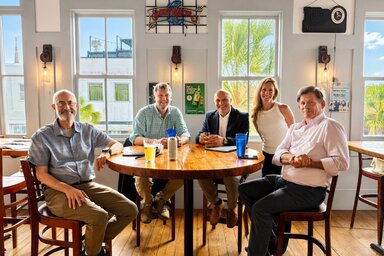


At the Medical University of South Carolina (MUSC), the path to groundbreaking clinical research is paved with collaboration, and the Research Opportunities & Collaborations (ROC) team is guiding the way. As a centralized contact for multisite study sponsors, the ROC team collaborates closely with industry leaders, Contract Research Organizations (CROs), Research Networks, and the National Center for Advancing Translational Science (NCATS) Trial Innovation Network (TIN) to connect MUSC investigators with promising clinical trial opportunities tailored to their specific expertise.
More than just matchmaking, ROC provides essential support that transforms ideas into active studies, facilitating the behind-the-scenes work that advances medical breakthroughs.
What ROC Brings to the Research Community
Whether you're an investigator looking to partner with industry, planning a new clinical trial, or expanding research into MUSC’s regional sites, ROC helps make the process clearer, faster, and more collaborative:
• Cross-Institutional Collaboration and Multisite Study Implementation
In support of the South Carolina Clinical & Translational Research Institute (SCTR), ROC promotes collaborative research opportunities with other institutions, strengthening MUSC’s role in multisite innovation through the Trial Innovation Network (TIN).
• Direct Access to Research Opportunities
ROC shares new opportunities aligned with investigators’ specialties, therapeutic areas, and research interests. ROC’s partnerships enable MUSC investigators to lead trials funded by industry, foundations, and federal sponsors.
• Strategic Site Selection & Feasibility Support
By leveraging tools such as TriNetX and Epic SlicerDicer, and by establishing relationships with top sponsors and CROs, including our strategic partners with IQVIA, PPD, Parexel, Alexion, and Novartis, ROC streamlines feasibility assessments and site selection processes.
• Hands-On Facilitation
From supporting site visits and teleconferences to facilitating the execution of Confidential Disclosure Agreements (CDAs) and Non-Disclosure Agreements (NDAs) with MUSC's Office of Research and Sponsored Programs, ROC ensures that all parties are aligned in their objectives and strategies.
• Regional Research Expansion Support
Through connections with MUSC Health Regional Research Expansion sites, ROC helps investigators expand into communities across South Carolina.
• Clinical Trialist Development
ROC team members are subject matter experts guiding study identification, feasibility and selection, budgeting, start-up, and management tailored to the specialties of investigators participating in SCTR’s Clinical Trialist Training Program (CTTP).
Meet the Team Behind the Momentum
| Signe Denmark | Kristen Clasen DeHart | Heather Hopmeier |
|---|---|---|
|
Associate Director ROC & Office of Clinical Research |
Program Manager ROC Metrics & Evaluation |
Program Coordinator ROC |
Together, they bring deep expertise in clinical research operations, feasibility assessments, and sponsor engagement. The ROC team is a trusted partner to investigators and external collaborators alike.
Since its launch in 2012, ROC—led by Signe Denmark—has built a powerhouse team delivering tailored expertise to the research community. From pinpointing viable opportunities to accelerating site selection and start-up, ROC continues to innovate with high-value services like clinical trial budget development, sponsor negotiations, and invoicing support.
Turning Potential into Progress
At MUSC, investigators rely on the ROC team for their clarity, collaboration, and commitment to research success. With a proactive mindset and strong communication, ROC helps researchers navigate feasibility and site selection with confidence—connecting studies to the right sponsors and opportunities.
This impact is exemplified by Heather Hopmeier’s support of an early-career faculty member in the College of Health Professions (CHP). Dr. Ryan Ross, Research Associate Faculty in the CHP Department of Health Sciences & Research, explains that during the pre-award phase of his first R01, the NIH requested MUSC stroke patient population data to ensure that he could achieve his stated recruitment goals. And, NIH required a response within 48 hours. Dr. Ross and his team immediately contacted ROC for assistance. “Heather’s guidance on patient query tools and data strategy, and swift response time, directly contributed to the successful award of my first R01 award,” shares Dr. Ross.
“We are extraordinarily fortunate to have such dedicated research data expertise on campus to assist the colleges with these rapid turnaround data requests,” says Randal Davis, Assistant Professor and CHP Director of Research Strategic Initiatives. “This is the third time Heather has helped our college with similar requests that resulted in positive results for funding or infrastructure development,” Davis explains.
Whether offering strategic insight or hands-on support, the ROC team plays a vital yet often behind-the-scenes role in advancing discovery. Their work ensures that promising ideas move beyond the page, toward funding, implementation, and real-world impact.
In the Spotlight: Heather Hopmeier
As Program Coordinator, Heather Hopmeier plays a vital role in ROC’s day-to-day operations, facilitating sponsor connections, supporting feasibility assessments, and helping investigators explore new trial opportunities. With four years in her current role, Heather brings both subject-matter knowledge and approachability to every interaction.
In our Q&A, Heather shares what drives her work, how she supports investigators, and what she finds most rewarding about being part of the ROC team.
Q&A with Heather
Q: Tell us about your pathway to becoming a Research Opportunities and Collaborations Program Coordinator for ROC.
I began my research career four years ago after moving to Charleston, South Carolina, when I was fortunate to be hired at MUSC. At the time, I was relatively new to the field and admittedly naïve about the complexities of research. However, this opportunity proved to be a turning point in my professional development. Through hands-on experience, mentorship, and a steep learning curve, I quickly gained a deep appreciation for the rigor and impact of clinical research.
Q: Describe your role in research. What drew you to this position?
In my role with the ROC team at MUSC, I support clinical research by connecting investigators with external partners, coordinating feasibility and site selection, and facilitating new trial opportunities. I was drawn to this position by a strong interest in collaborative research and the opportunity to contribute to advancing patient-centered studies through strategic support and partnership-building.
The Pediatric Research Group has received outstanding support from ROC. Their partnership has greatly contributed to securing numerous valuable new study opportunities. In particular, working with Heather has been exceptional. Heather is always extremely responsive, consistently supportive, and willing to go above and beyond to ensure our success.
Q: Walk us through a typical day for you at ROC.
A typical day in the ROC department involves constant communication—lots and lots of emails! I regularly engage with study teams, Contract Research Organizations (CROs), and Sponsors to keep clinical trial opportunities progressing efficiently. My responsibilities include identifying appropriate clinical trials for MUSC Principal Investigators, facilitating feasibility and site selection, and meticulously documenting all progress in our internal ROC database.
We also utilize self-service feasibility tools to generate patient count estimates and support internal consultations. These tools, combined with strong collaboration across departments, help ensure that studies are matched accurately and move forward smoothly from outreach to activation.
Q: Give an example of how a feasibility consultation can contribute to the success of a research project.
A feasibility consultation plays a critical role in the success of a research project by ensuring alignment between the study's requirements and the site's capabilities. It helps assess patient availability, investigator experience, and operational resources early in the process. This allows for informed decision-making, improved protocol fit, and ultimately faster site activation and stronger enrollment outcomes.
Q: Describe one resource that researchers underutilize. What do you wish researchers knew?
One resource that researchers often underutilize is the feasibility and site-selection support offered by research administrative teams—like the ROC department. Many investigators may not be aware of the tools available to assess patient population, operational capacity, or protocol fit before committing to a study. Engaging with these services early can help researchers avoid misaligned trials, improve site selection outcomes, and strengthen Sponsor/CRO relationships.
Q: What is the most meaningful part of your job?
The most meaningful part of my job is knowing that I play a role in bringing potentially life-changing clinical trials to our institution. Even though I’m not at bedside or in the lab, I help ensure that promising studies reach the right investigators and that we’re well-positioned to participate. It’s rewarding to know that the behind-the-scenes work—coordinating with sponsors and reviewing feasibility—ultimately contributes to advancing medical research and patient care.
Working with ROC and Heather Hopmeier truly makes our lives easier. Heather is excellent at what she does and provides top-notch customer service. One of the best things about working with ROC/Heather, is that you can truly go to her and ask for help (even if you are unsure if it would be something she can assist with), and Heather will do an amazing job at helping to connect you with the right person. You also never have to worry about following up on what she is working on, as she provides timely updates (even if there is no update to give). We appreciate ROC’s service and the support provided to our team, and we could not do without her!
Q: What advice do you have for anyone who may be considering a research career?
If you’re considering a career in research, my biggest advice is to stay curious and be open to learning every day. Research often involves navigating uncertainty and complexity, so patience is key. Don’t be afraid to ask questions and seek mentorship—learning from experienced colleagues can accelerate your growth.
Connect with the ROC Team
To learn more or to request a consultation visit, please contact the ROC team at researchoppcollab@musc.edu.
Learn More about SCTR’s Multisite Clinical Trial Support Program

Danielle Hutchison
SCTR Communications Manager
Danielle Hutchison manages the Communications Program for the South Carolina Clinical and Translational Research Institute at MUSC.