

The following is the second in a 2-part discussion with experts from SCTR’s Dissemination and Implementation (D&I) Science Collaborative (DISC) during which we learn more about the impact of this field of research. If you missed Part I, you can go back and visit the first post to learn more about how D&I science is defined, how to develop a research question, and where to find tools related to Implementation Science conceptual models.
In Part II, DISC experts share details on resources available to assist with designing a D&I study and when and how to prepare for a consultation. Regardless of your level of experience as a D&I researcher, the DISC web page is a great place to start as the team shares a variety of education and funding opportunities, toolkits, success stories, as well as more information about consultative services.
Are there resources available to assist with designing a D&I study including identifying an effective research question?
Dee Ford
That’s what DISC hopes to help investigators at MUSC accomplish.
Katherine R Sterba
We do presentations for teams interested in learning more and getting an introductory lecture around implementation science. We had a scientific retreat last September, and are always thinking about the next steps for training locally and around the state.
Our consultation services are really for anyone, early-stage investigators and more advanced investigators who are getting into the field. We're happy to help with research questions, aims, methods, models, and tools. We can also help connect teams with collaborators in this area at any stage of your research.
“We study the best approaches to getting information and interventions into communities. There's so much value in community and stakeholder engagement in this field.” -- Dr. Caitlin Allen
Through SCTR’s Clinical and Translational Science Award (CTSA), DISC offers free consultations and presentations. You can submit a request through SPARCRequest and provide us with some information about your protocol, your research area, and any specific questions. You can request a variety of different services based on your interest in methods and measures, presentations, or conceptual frameworks.
How does implementation science address the health equity question?
Katherine R Sterba
Health equity is a major focus of implementation science. The last thing we want to do is develop new evidence-based practices or interventions that would help patients we're not able to reach.
Reaching patients in an equitable way is such an important research question throughout the process of taking discovery to practice. There are a lot of good D&I health equity-focused conceptual models in development.
Caitlin Allen
Implementation science has shifted and evolved toward emphasizing equity. There's been so much coming out recently from the National Cancer Institute. They are a powerhouse in the space of health equity, which is a huge emphasis and undercurrent of implementation science. To some extent pre-pandemic, but certainly, it has moved more to the forefront since COVID.
Are there additional factors to consider when it comes to establishing partnerships and collaborations for a D&I research study?
Katherine R Sterba
A diversity of perspectives is critical for this kind of work. When building teams, it's important to have shared goals and build trusting relationships. Researchers cannot come in and then leave immediately when the funding ends. You need to be truly committed to improving outcomes within your area of shared interest.
We often pull together teams and advisory boards with community members, scientific experts in the field, and others who have a perspective on the health problem you are studying. They can help guide the research questions, the methods, the relationship building, and all aspects of the research.

You may also discover over the course of your research that you missed some people or that new stakeholders have emerged. It’s important to be willing and able to pivot and bring in new voices along the way. Additionally, for clinical researchers, it can be especially challenging wrapping your head around implementation outcomes. It requires a different approach than traditional clinical or translational research.
What has experience taught you?
Katherine R Sterba
The field has evolved like any field. Years ago, we didn't have validated tools to assess barriers and facilitators to implementation. We also didn't have good tools to measure implementation outcomes.
Now I feel like we're catching up with ourselves and we've got better measurement tools and have applied D&I principles to a wide variety of different content areas. We also have more experience. As an implementation scientist myself, I think I've evolved to think about things much earlier, from the early planning steps to developing an innovation or an intervention.
Caitlin Allen
I remember in graduate school making logic models in an evaluation class and thinking about evaluation outcomes. At that time the thinking was, this is important to think about at the beginning but not practical. Now, it’s accepted that you have to think about implementation and evaluation science from the very beginning.
The other thing experience has taught me is the value of community engagement in this space and the importance of community engagement throughout the implementation of your interventions. We study the best approaches to getting information and interventions into communities. There's so much value in community and stakeholder engagement in this field.
“It's important to be willing and able to pivot and bring in new voices along the way.” -- Dr. Dee Ford
Community engagement can come in from the early stages, so maybe it's important to have a randomized control trial (RCT) be tightly controlled. As you're doing that type of work, you could still have the qualitative data, the Community Advisory Board, and the stakeholder engagement aspects that are helping to inform steps along the way. Some situations require RCTs or more pragmatic situations.
How do Quality Improvement and Dissemination and Implementation Science differ?
Dee Ford
The nomenclature and time horizons are different. The terminology used and the methods are also quite different. Quality improvement typically has clinical and patient stakeholders, as well as family stakeholders, but it’s expected to proceed at a pretty quick pace with rapid cycles of planning, doing, studying, and acting – then refinement over time. It’s not grounded in the scientific method and isn’t hypothesis testing. QI teams are usually clear on where and what endpoints are important and are seeking the most expeditious pathways.
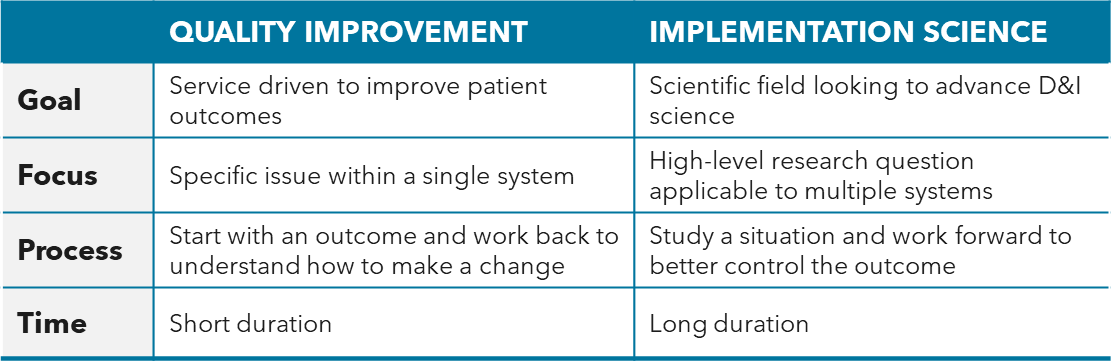
Implementation Science will have a more thoroughly thought out set of aims and a longer time in which to complete the work as compared to quality improvement. There are differences but the objective of both is the same - better implementation of best practices and improving care outcomes and policy.
When designing a D&I research study, at what point is it best to request a consultation?
Katherine R Sterba
We receive all kinds of consultation requests and welcome them all. Sometimes people come to us after they've put in a grant and their reviewers have told them that they would benefit from an implementation science aim or framing, and we can help with the grant review and grant revision. Sometimes people come to us very early when they're developing an intervention. It’s good to be thinking ahead about what you can build into your study to monitor implementation processes, even from the very beginning. However, keep in mind, we can’t define best practices for implementation before establishing an evidence-based intervention. However, it's never too soon to start monitoring these processes in your early studies so that you have preliminary data around implementation.
We have excellent resources on our website that offer a good first step in preparing for a consultation. You can find an overview of the field and review key articles and published toolkits with tips for research steps and implementation science. There are also a variety of different training and funding opportunities on our website, which we recommend visiting before coming to a consultation.
Caitlin Allen
Right now there is an abundance of educational opportunities to dip your toes into D&I. We’re available to guide and offer support regardless of where folks are or how they feel about their experience in this space.
***********************************************************************************
Dissemination & Implementation Research Interest Group
The Dissemination & Implementation Research Interest Group brings together researchers interested in learning more about implementation science. Participation is open to those new to the field, as well as those who may already be engaged in implementation research. The group is fortunate to have outstanding members, several of whom are outside of MUSC. All meetings are held via Zoom, the 2nd Friday of the month at 1 p.m. If you are interested in participating, please register here. You only need to register once. Questions can be emailed to Rochelle Hanson.