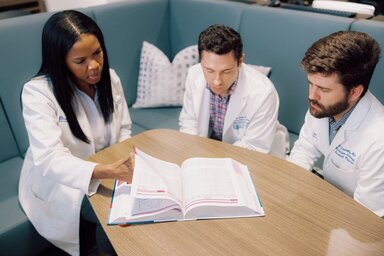

On Friday, Nov. 13, the South Carolina Clinical & Translational Research (SCTR) Institute presented its annual Mentorship Training Symposium, spotlighting time management and artificial intelligence (AI) in mentoring. The event provided practical, timely mentor-development training for the MUSC research community, including mentors and mentees, faculty, staff, trainees and postdoctoral scholars.
Mentor Leadership Council chair and distinguished professor Carol Feghali-Bostwick, Ph.D., and the SCTR Workforce Development team sought to create an event centered on immediately applicable, highly relevant topics that fostered a welcoming, collaborative environment.
“It is important to leverage opportunities such as this symposium to hone mentoring skills, keep up with an evolving mentoring culture and interact with a community of mentors and mentees who are engaged and open to learning more,” she said.
It is important to leverage opportunities such as this symposium to hone mentoring skills, keep up with an evolving mentoring culture and interact with a community of mentors and mentees who are engaged and open to learning more.
The first session focused on time management, a universal challenge that affects researchers, faculty members, mentors, staff and trainees alike. The keynote workshop by University of Iowa’s Susan R. Johnson, M.D., author of the blog “Thriving Amidst Chaos” taught attendees organizational, planning and productivity tactics. The aim was for participants to leave with practical strategies they could apply immediately within both their daily work and their mentoring relationships.
MUSC Chief Artificial Intelligence Officer Marylyn Ritchie, Ph.D., led the second session that explored the role of AI in mentoring. As AI rapidly transforms research and increasingly influences how mentors and mentees work, Ritchie provided a timely overview of tools, guidelines for appropriate and compliant use of technology and how AI can augment, rather than replace, effective mentoring relationships.
While the annual symposium serves as the program’s flagship event, it also supports work that is conducted throughout the year through offerings such as the Mentoring Fundamentals course.
The self-paced online course of study is offered four times a year and serves as SCTR’s foundational mentor-training program. The course was recently refined as part of a broader effort to strengthen mentorship development across the institution and includes interactive activities, quizzes, downloadable resources and more.
By the end of the course, participants will have developed real-world skills to support mentor-mentee relationships, such as how to conduct needs assessments, create mentoring compacts and communicate effectively.
Mentoring Fundamentals serves as a gateway to the Center for the Improvement of Mentored Experiences in Research (CIMER) training, a broader effort to provide standardized, evidence-based mentorship training across the national network of Clinical and Translational Science Award (CTSA) hubs, of which SCTR is a part. After course completion, trainees are invited to participate in facilitated in-person CIMER workshops that build upon the concepts introduced online.
In addition to offering Mentoring Fundamentals and nurturing future academic leaders, Feghali-Bostwick and the Mentor Leadership Council are working to make MUSC a centralized hub for clinical and translational research mentoring resources across the institution and beyond. Workforce Development coordinator Kristen Briggman facilitates both the course and the annual symposium and described the team’s larger mission: “Mentors need support groups, resources and connections with other mentors. We’re trying to consolidate resources and make mentoring support easier to access.”
Mentors need support groups, resources and connections with other mentors. We’re trying to consolidate resources and make mentoring support easier to access.
Briggman also stressed that effective mentoring requires more than just research expertise. Beneficial mentor-mentee relationships, she said, require communication skills, accountability, boundary setting and commitment from both parties.
“It’s difficult to be a good mentor while also being good at what you do,” she said. “There’s so much involved.”
For questions, please contact sctr-workforcedeve@musc.edu
Sophia Barry Gordon
Sophia Barry Gordon is the science writing and communications program coordinator at the South Carolina Clinical & Translational Research (SCTR) Institute. She holds a Master of Science degree from New York University and is currently a Ph.D. candidate at the University of Birmingham (UK).