
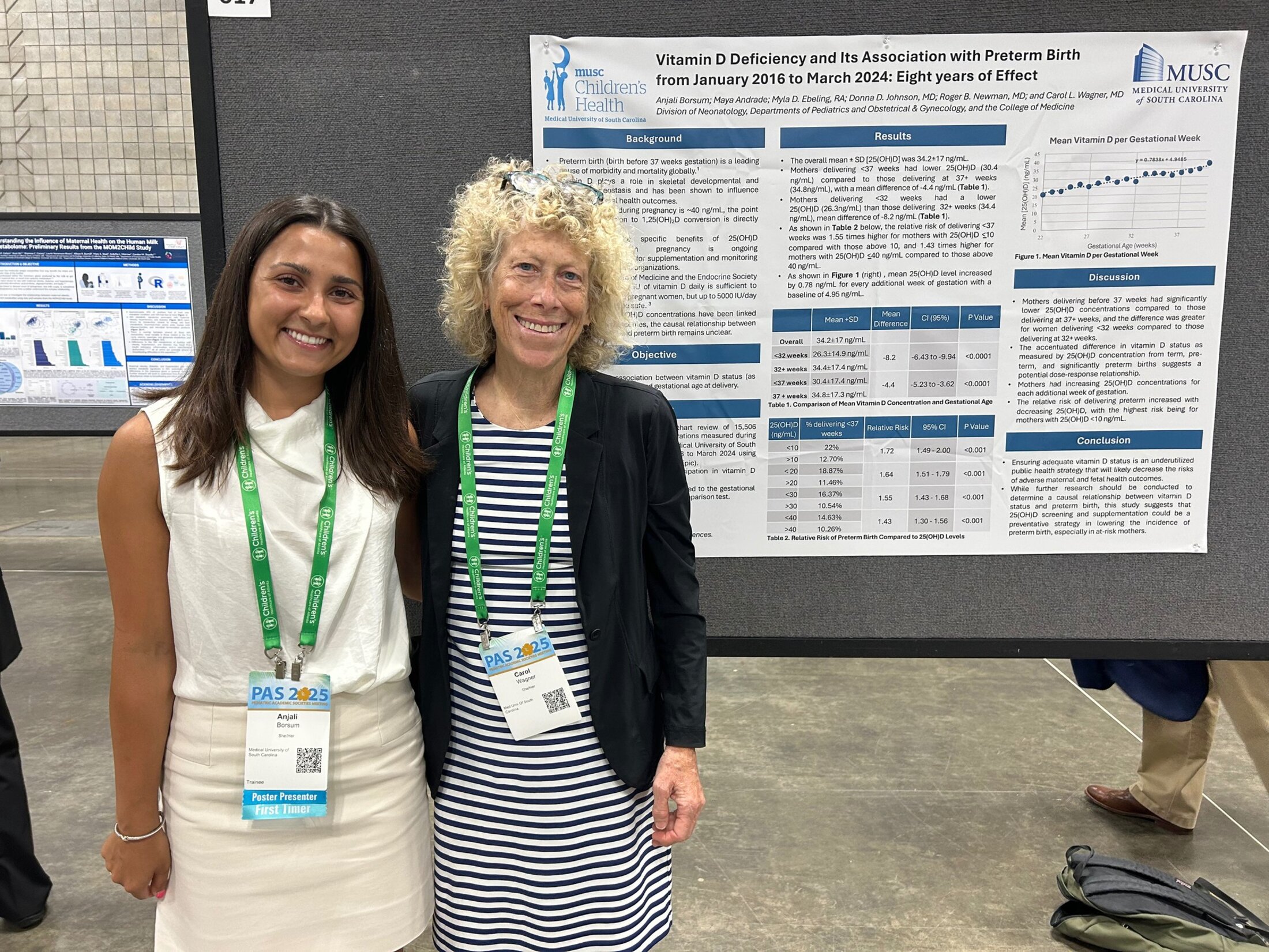
A common and often overlooked nutrient deficiency may play a bigger role in pregnancy outcomes than previously recognized. In a recent analysis published in the Journal of Perinatology, prominent neonatologist and pediatrician Carol L. Wagner, M.D., and Anjali G. Borsum, an M.D. candidate at MUSC’s College of Medicine, found that among more than 15,000 pregnancies studied at MUSC, the women with the lowest vitamin D levels faced the highest risk of preterm birth.
Drawing from a large retrospective dataset collected between 2016 and 2025 and leveraging extensive support from the South Carolina Clinical & Translational Research (SCTR) Institute, including biostatistical and regulatory guidance, clinical research infrastructure, laboratory services and Nexus data resources, Wagner and Borsum identified a strong association between profound vitamin D deficiency and earlier gestational age at delivery. Wagner credited SCTR’s comprehensive support as instrumental to the study’s success.
“Without SCTR, we as a team would never have been able to accomplish what we did. It’s a phenomenal infrastructure and an incredible gift to any researcher.”
While the team has not yet established a definitive causal relationship, the findings add to a growing body of evidence suggesting that optimizing a patient’s vitamin D status before and during pregnancy may improve both maternal and fetal health outcomes.
Why vitamin D might matter in pregnancy
Vitamin D is a vital nutrient that is known primarily for helping the body to absorb calcium and maintain normal bone, muscle, nerve and immune health. But as Wagner and fellow MUSC basic and translational scientist Bruce W. Hollis, Ph.D., discovered in earlier randomized controlled trials, vitamin D acts as a building block for hormones that play an important role in pregnancy.
Vitamin D impacts literally thousands of genes in the body.
“Vitamin D impacts literally thousands of genes in the body,” said Wagner. Research suggests that vitamin D helps the development of the placenta, the temporary organ that grows in a pregnant woman to nourish the fetus. It also appears to help support healthy immune function and may reduce the risk of serious complications like preeclampsia and gestational diabetes.
One crucial function vitamin D seems to serve is helping the mother’s immune system to adapt to pregnancy. Because a baby in utero contains genetic material from both parents, the mother’s body must learn to tolerate something that is partially foreign. Vitamin D may help to regulate that process, supporting a healthy pregnancy and fetal development.
Beyond pregnancy: Vitamin D’s broader health role
According to Wagner and Borsum, vitamin D may shape long-term health more than immediate outcomes. Some of the effects of deficiency may begin early in development, altering how genes function and potentially influencing the baby’s health for years, or even decades, to come.
Even outside of pregnancy, vitamin D deficiency is far more common than many people realize. Modern lifestyles often limit time spent outdoors, reducing the body’s ability to produce vitamin D from sunlight. At the same time, food sources provide only a small portion of the vitamin D most people need. As a result, many individuals do not reach healthy vitamin D levels.
Some groups are at higher risk for deficiency, including people with darker skin, those who work indoors, individuals who regularly use sunscreen and people with limited mobility or chronic health conditions that keep them inside.
The team stresses that sunscreen remains essential for protecting against skin cancer. However, people with limited sun exposure may benefit from discussing their vitamin D levels and potential supplementation with their health care provider.
“We have to balance the importance of sunshine and vitamin D with the risk of skin cancer,” said Borsum. “But this further emphasizes the vast role vitamin D plays.”
Emerging research suggests that vitamin D helps to regulate thousands of genes throughout the body, particularly those involved in immune function. Low levels have been associated with autoimmune diseases such as lupus and multiple sclerosis as well as certain cancers.
Challenges of turning research into practice and future directions
Despite growing evidence supporting the importance of vitamin D, Wagner said changing clinical practice can be difficult. Unlike prescription medications, vitamin D is inexpensive, widely available and cannot be patented, which means there is less commercial impetus to promote its use. “No one’s going to make billions off of this,” Wagner explained. “So, it then becomes a public health issue.”
As researchers continue to build evidence about the role of vitamin D in pregnancy and overall health, Wagner and Borsum see the next steps as educating health care providers, continuing to investigate vitamin D’s long-term effects and increasing public awareness.
I always tell my friends and family who are thinking about becoming pregnant to make sure they are [vitamin D] sufficient!
“We learn about vitamin D’s role in bone health, but no one teaches us about the various roles in pregnancy, especially this relationship with preterm birth we are uncovering,” Borsum explained. “I always tell my friends and family who are thinking about becoming pregnant to make sure they are sufficient!”
As researchers continue to uncover vitamin D’s far-reaching effects, Wagner and Borsum hope the growing body of evidence will encourage more conversations about a nutrient that may shape health across generations.
Reference
Borsum, A.G., Andrade, M.F., Ebeling, M.D. et al. Maternal vitamin D status and preterm birth: an eight-year retrospective cohort study in the Southeastern United States. J Perinatol 46, 1300-1306 (2026). https://doi.org/10.1038/s41372-026-02757-z
About MUSC
Founded in 1824 in Charleston, the Medical University of South Carolina (MUSC) is the state’s only comprehensive academic health system, with a mission to preserve and optimize human life in South Carolina through education, research and patient care. Each year, MUSC educates more than 3,490 students in six colleges and trains more than 1,175 residents and fellows across its health system. MUSC leads the state in research funding from the National Institutes of Health, including National Institute of General Medical Sciences COBRE awards. For information on our academic programs, visit musc.edu.
As the healthcare system of MUSC, MUSC Health is dedicated to delivering the highest-quality and safest patient care while educating and training generations of outstanding healthcare providers and leaders to serve the people of South Carolina and beyond. In 2026, for the 12th consecutive year, U.S. News & World Report named MUSC Health University Medical Center in Charleston the No. 1 hospital in South Carolina. To learn more about clinical patient services, visit muschealth.org.
MUSC has a total enterprise annual operating budget of $10.1 billion. The more than 37,130 MUSC members include world-class faculty, physicians, specialty providers, scientists, contract employees, affiliates and care team members who deliver groundbreaking education, research and patient care.
About the South Carolina Clinical & Translational Research Institute
The South Carolina Clinical and Translational Research (SCTR) Institute is the catalyst for changing the culture of biomedical research, facilitating sharing of resources and expertise and streamlining research-related processes to bring about large-scale change in the clinical and translational research efforts in South Carolina. Our vision is to improve health outcomes and quality of life for the population through discoveries translated into evidence-based practice. To learn more, visit https://research.musc.edu/resources/sctr

Sophia Barry Gordon
Sophia Barry Gordon is the science writing and communications program coordinator at the South Carolina Clinical & Translational Research (SCTR) Institute. She holds a Master of Science degree from New York University and is currently a Ph.D. candidate at the University of Birmingham (UK).
Recent News Releases stories