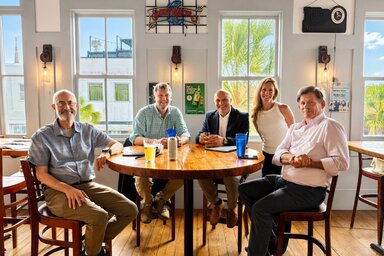


At the heart of MUSC’s SUCCESS Center, the Regulatory Knowledge and Support (RKS) team serves as a trusted partner to investigators and study teams navigating the complex landscape of research regulation. Led by experienced specialists Katherine Bright and Leslie Bell, RKS provides expert, no-cost consultations on every aspect of the research lifecycle—from electronic Institutional Review Board submissions and FDA or Institutional Biosafety Committee filings to study documentation and Good Clinical Practice. Drawing on decades of combined experience and a deep understanding of both federal regulations and MUSC’s local policies, the team empowers- researchers to move their studies forward with clarity, confidence, and compliance, ensuring that groundbreaking discoveries reach the patients and communities they’re meant to serve.
What They Do
The Regulatory Knowledge and Support (RKS) team at the SUCCESS Center helps investigators and study teams confidently navigate the regulatory landscape of research at MUSC. Their free services include:
- Human Subjects Regulatory Consultation – Guidance on all aspects of human subjects research, including eIRB submissions, protocol and consent development, study documentation, and FDA or IBC submissions.
- Basic Science/Animal Regulatory Consultation – Support for regulatory components of translational research, such as IACUC and IBC submission consultation.
- Regulatory Document Review – Specialized training in organization and maintenance of essential study documents, as well as audit prep, including mock audits.
- FDA Submissions Support – Assistance with preparing and understanding the requirements for FDA submissions related to clinical research.
- Training and Resource Development – Creation of presentations, educational sessions, and tools to help study teams better understand regulatory requirements and best practices.
- Mentorship and Early Career Guidance – Helping students, trainees, and new investigators learn how to conduct compliant, meaningful research early in their careers.
- Personalized, Practical Advice – Offering detailed, actionable guidance that helps study teams understand why regulations exist and how to apply them efficiently in future projects.
Profiles in Excellence: The RKS Team
Meet the small but mighty team behind RKS’s mission:
Leslie Bell, MA, CCRP – Regulatory Lead – With a wide breadth of regulatory expertise, Leslie brings her experience as a clinical research coordinator to her role at RKS to assist study teams in understanding how the regulations impact the day-to-day conduct of a study.
Katherine Bright, CIP – Regulatory Coordinator – Katherine brings a depth of experience and knowhow in her understanding of the regulations surrounding human subjects protection, having worked for multiple IRBs in the past.
Together, Leslie and Katherine tag team RKS’s consultation requests, which include but aren’t limited to protocol/consent/IRB application reviews, reviews of regulatory binders and assisting with FDA submissions. They also work together on the development of presentations and trainings and the creation of new tools and resources.
So many investigators get frustrated with the submission process and are ready to throw in the towel, so it's rewarding to be able to help them make it to the finish line and get started with the study.
Deep Dive: Q&A with Our Specialists
Q: What are some of the key strengths and characteristics of the RKS team and the services you offer?
Our services are free! We are well-versed in both the federal regulations that drive human subjects protection requirements, as well as MUSC’s local policies and procedures. We strive to provide extremely detailed guidance and instruction in each of our consultations. We cannot do the work for the study teams, but we make sure they have a clear understanding of the information and a plan for how to move forward to successfully achieve their aims (whether that's an IRB submission, having a successful audit, etc.).
We ensure that we give feedback that not only provides detailed and specific guidance for the specific project they are currently working on, but also a more global understanding of the regulations that can be applied to future projects as well. We also strive to make study teams/investigators familiar with the tools and resources that are available to them, so that throughout their tenure at MUSC, they know how to conduct projects in the most efficient way that involves the least regulatory burden.
Q: How many years of experience do you have in research and within RKS?
Leslie has worked in research for over 15 years, at SCTR for 12, and as a member of RKS for about 10. Katherine has 17 years of experience in the field of human subjects research regulation and support. Katherine worked in various positions within the MUSC IRB office, served as an IRB Reliance Manager at another university, then returned to MUSC and joined the RKS group in 2021.
Q: What is the most meaningful part of your job?
Assisting investigators with succeeding in their regulatory submissions for projects that could really impact patients. Human subjects research cannot happen without appropriate approvals, no matter how important the study may be to patients/society. So many investigators get frustrated with the submission process and are ready to throw in the towel, so it's rewarding to be able to help them make it to the finish line and get started with the study. [BGS1.1]It's also great to be able to catch students and trainees early in their career and show them how important research can be to their career, and how to get involved in it early, in meaningful ways.
We’ve seen extremely successful and conscientious researchers get surprised by how much they underestimated or misunderstood the process. MUSC researchers are lucky to have the plethora of free resources that SCTR offers.
Lessons Learned from the Experts

1. Don't bite off more than you can chew. Successful projects do not have to mean that the project is a large enrolling, multi-site, clinical trial. Dip your toes in the research pool, with ‘Not Human Subjects Research’ or exempt studies. Start off as a co-investigator or study staff on a larger project to gain some experience. Once you have your feet wet, you can start developing larger projects, so long as the work is meaningful, and you have the time to dedicate to it.
2. Work with colleagues or mentors who have clinical research experience here at MUSC. This is especially true for students/trainees, but also for young faculty, or faculty new to the institution. Every institution has different institutional policies and local laws that impact research conduct and IRB review. It will save an investigator a lot of time if they have a dedicated person they can go to when they have questions about the research process here at MUSC.
3. Get help/guidance early in the process if you need it. Come to us for a regulatory consultation as you are starting to draft your project, so we can tell you if it needs IRB approval, and if so, what level of review and what documents are required as part of that review. Even if you have research experience, don't forget to utilize our available tools and resources to make sure you're saving yourself extra time and burden.
4. Very few people can successfully “wing it” when it comes to an IRB application and satisfying post-approval regulatory requirements. We’ve seen extremely successful and conscientious researchers get surprised by how much they underestimated or misunderstood the process. MUSC researchers are lucky to have the plethora of free resources that SCTR offers. Please come see us early and often!
Connect with the RKS Team
Leslie Bell
Regulatory Lead
bella@musc.edu
Katherine Bright
Regulatory Coordinator
duncank@musc.edu
Sophia Barry Gordon
Sophia Barry Gordon is the science writing and communications program coordinator at the South Carolina Clinical & Translational Research (SCTR) Institute. She holds a Master of Science degree from New York University and is currently a Ph.D. candidate at the University of Birmingham (UK).